Laravel Extended Relationships

Additional Eloquent relationships for related records connected through multiple keys.
Screenshots
About Laravel Extended Relationships
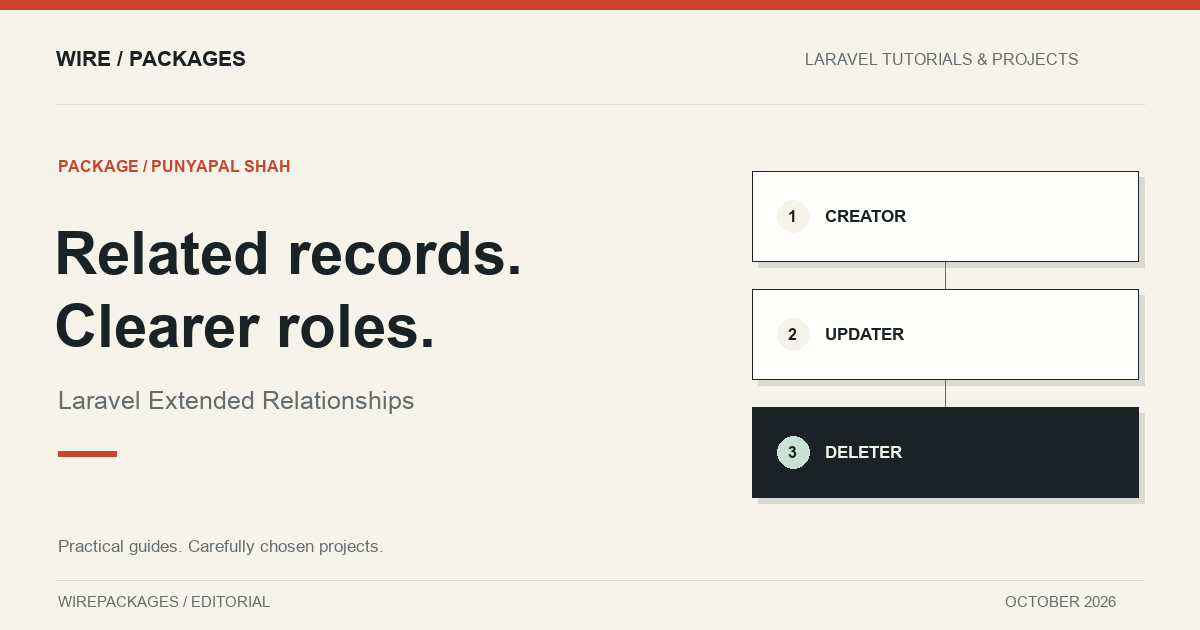
Laravel Extended Relationships is a package by Punyapal Shah for Eloquent models whose related records are connected through several keys. Its documented examples include an audit trail where one record points to the user who created it, the user who updated it and the user who deleted it. The package gives those related roles a shared relationship interface.
This is a focused Eloquent extension. It does not replace your application's data model or make every relationship more efficient by default. Its value depends on whether the particular multi-key pattern matches your schema and whether the resulting interface is easier for your team to understand than several ordinary relationships.
The problem behind the package
An audited record often has several user references. Displaying a history panel may require all of them, while a conventional model exposes each role separately. The package's README demonstrates grouping those role-based references so that the application can retrieve the related users together and still address them by their meaningful role names.
That is useful when the grouping represents one concept in the domain. A set of audit actors belongs together because the interface needs to explain a record's history. It is less convincing when unrelated associations are merged merely to save a few method declarations. Keep the model expressive even when optimising how data is loaded.
Before adopting the abstraction, write down the queries your existing screen performs. Measure the ordinary Eloquent implementation with appropriate eager loading, then compare the package-backed version on representative data. The right comparison is the workload your application actually runs, including nullable keys and repeated users.
Read the relationship names carefully
The current README introduces the HasExtendedRelationships trait and a belongsToManyKeys relationship for the audit-actor example. It also documents an inverse hasManyKeys relationship for finding records associated with a user through several roles. Those names describe the package's current interface more precisely than a generic claim about advanced relationships.
The mappings give the application a way to distinguish creator, updater and deleter even when two roles refer to the same person. That distinction matters when presenting an audit history. The fact that two foreign keys currently contain the same identifier does not mean the roles have identical business meaning.
Review how missing actors behave in your own application. A deleted user, a system-created record or an operation without a logged-in user can leave an audit field empty. The surrounding interface should have a deliberate explanation for that state instead of assuming every role always resolves to a person.
Keep ordinary model design intact
The package extends Eloquent relationships, so the rest of the model still needs the usual care. Use meaningful foreign-key names, database constraints where appropriate and a clear policy for deleting referenced records. A custom relationship cannot recover the intention of a schema whose keys are ambiguous.
Authorisation remains separate from loading related users. Being able to retrieve an audit actor does not grant a caller permission to view that person's private profile or the audited record. Return only the fields needed by the interface, and apply the normal policies and API resources around the response.
The same principle applies to tenant boundaries. If an application groups records by organisation, test that the relationship queries respect the intended scope. Custom query behaviour deserves particular attention when a model relies on global scopes, soft deletion or multiple database connections.
Evaluate with a representative example
A useful spike starts with a small set of records that covers several cases: three different actors, one actor in several roles and a missing optional actor. Render the screen that needs those relationships and inspect both the data returned and the queries executed. That reveals whether the package's grouped interface fits the application.
Include eager-loading behaviour in the check. A relationship can work when accessed on one record and behave differently when a collection is loaded. Test the list page as well as the detail page, particularly if the original motivation was reducing queries across many records.
When adding automated coverage, assert the meaningful roles and records rather than only the number of queries. Query counts are useful evidence, but a lower count is not a success if the wrong actor is associated with a record. Correctness comes first, followed by the measured performance of the intended access pattern.
Compatibility and maintenance
The current repository manifest declares support for Laravel 12 and 13 through its Illuminate dependency constraint, alongside current PHP constraints. Check the released package version you install, because a repository's default branch and the latest tagged release are not always the same dependency set.
The package is distributed through Composer and uses the MIT licence. Its repository contains the implementation and tests, which are useful references when a relationship interacts with a less common part of your model. Read those alongside the README rather than relying on a short directory description for every supported edge case.
Punyapal's own open-source page identifies this as a package he authored and maintains, and the repository sits under his account. That makes it a suitable entry for this collection of his own projects. It is distinct from the larger ecosystem repositories where he contributes as a collaborator or core team member.
Sources: Laravel Extended Relationships repository, Composer package, and Punyapal Shah's project page. The directory card is original editorial artwork identifying the package, rather than an invented application screenshot.
Reviews
Used Laravel Extended Relationships? Share your experience.
Log in to reviewNo reviews yet
Used it? Be the first to leave a rating.