Laravel Auth Jobs

Carry authenticated user context into Laravel jobs with dedicated queue middleware.
Screenshots
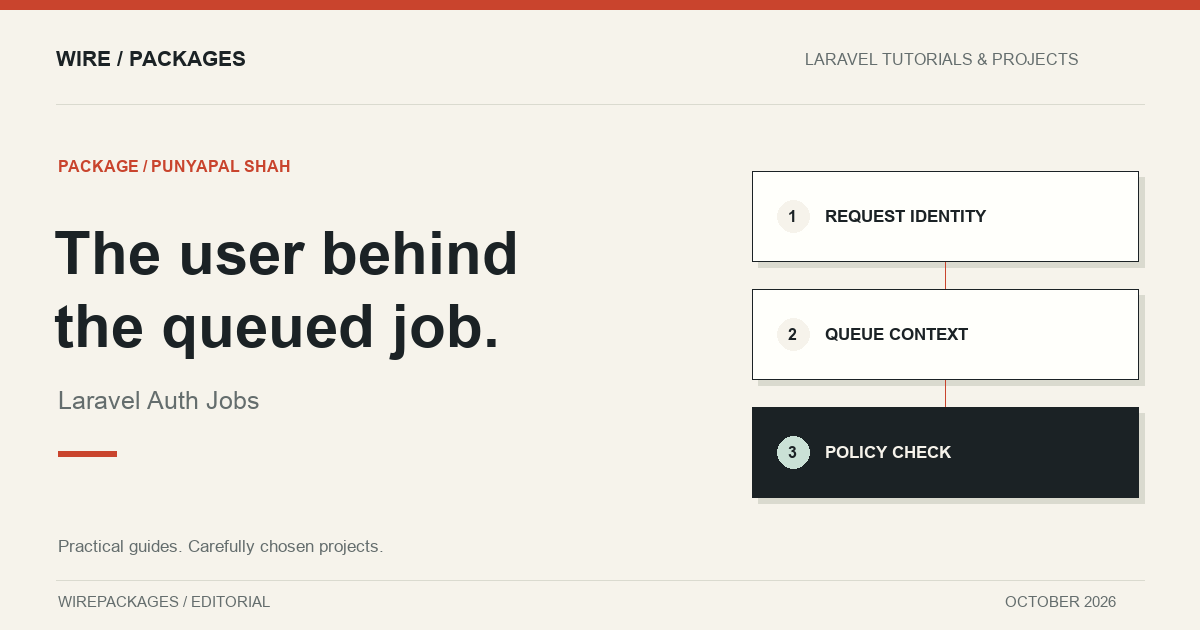
About Laravel Auth Jobs
Laravel Auth Jobs is Punyapal Shah's package for carrying an authenticated user's context into queued work. Its documented middleware makes the originating user available while a job is processed, which can be useful when the job needs to apply the same user-aware rules as an ordinary request.
The problem is easy to overlook during early development. A request has a current user, so code called directly from that request can read the authentication state. A queue worker runs later in a different process. Moving the operation into a job changes the execution context, even when the handler looks almost identical to the original controller code.
User context is part of the job's meaning
Consider a report requested by someone who belongs to an organisation. The report may need to know which person requested it, which records that person may access and how to attribute the operation. Those are application decisions that should remain explicit when the work moves into a queue.
The package provides middleware for restoring authentication context during job processing. The README shows a job using AuthenticateJob middleware, then accessing the authenticated user inside its handler. It also shows a policy check, which is an important distinction: restoring identity does not by itself authorise every operation the job might perform.
Decide whether the job acts as the requesting person or as a system process. A scheduled maintenance job may have no human user at all. An import started by an administrator may need an audit identity without inheriting every part of that administrator's request context. Do not force every background operation into the same model simply because a convenient authentication helper exists.
Permissions can change while a job waits
A queue introduces time between acceptance and execution. During that interval, a user can lose access to an organisation, a record can be deleted or an operation can become invalid. A job that relies on user permissions should check the relevant rule when it performs the protected action.
That does not always mean repeating every request validation step. It means distinguishing immutable inputs from decisions based on current state. A report identifier may remain a valid integer while the permission to read that report has changed. Keep the policy responsible for the latter instead of treating the payload as a permanent permission grant.
Plan the failure behaviour too. If access is no longer available, decide whether the job should stop, record an expected failure or notify the requester through an appropriate channel. Retrying the same denied action indefinitely is unlikely to improve the result. Make that behaviour part of the feature's tests.
Understand the configured middleware groups
The package's published configuration identifies the middleware groups whose requests provide the authentication data. The documented default includes the web group, with an API group shown as an option. That means the way a job is dispatched matters: a browser request, an API request and a command-line task do not automatically have identical context.
Check the entry points that actually dispatch your jobs. If the application uses token authentication, a custom guard or more than one user model, inspect the package's current behaviour against that setup. Avoid assuming that a successful example using the default web guard proves every authentication arrangement is covered.
The repository also supports custom context-key providers through a documented contract. This can be useful when an application has existing context conventions or needs to avoid naming collisions. Keep those keys central and stable, because dispatching and processing need to agree about what the stored context represents.
Test a real queue boundary
A synchronous dispatch can hide problems that only appear after serialization and worker execution. For an integration test, dispatch through the same kind of authenticated request the application uses, store the job on a real test queue and process it with a worker. Assert the identity seen by the handler and the outcome of the policy check.
Add cases for an unauthenticated origin, a removed user and a user whose permissions change before execution. Also process jobs for different users through the same worker lifecycle. Long-running workers make isolation especially important: one job's authentication state must not become the next job's identity.
These tests should check behaviour rather than merely assert that middleware appears in an array. Registering the middleware is necessary, but the feature depends on the whole journey from request context to queued payload to handler. Use a small, observable operation so that failures are easy to understand.
Keep business operations reusable
The job can delegate its actual work to an action with explicit inputs. That keeps the operation readable and makes it easier to test application behaviour separately from queue-context integration. The job remains responsible for the background execution boundary, while the action describes what the application does.
Where practical, pass the relevant actor into the action rather than making every lower-level service discover it globally. The package can restore the authenticated user at the boundary without forcing the whole codebase to depend on ambient authentication state. Explicit dependencies make CLI, scheduled and interactive callers easier to compare.
The current repository manifest targets Laravel 12 and 13 with modern PHP constraints, and the package uses the MIT licence. Check the tagged release selected by Composer and the upstream tests when adopting it. This is a focused utility for a real queue boundary, not a replacement for policies, tenant isolation or a deliberate retry strategy.
Sources: Laravel Auth Jobs repository, Composer package, and Punyapal Shah's project page. The image is an original editorial card identifying the package.
Reviews
Used Laravel Auth Jobs? Share your experience.
Log in to reviewNo reviews yet
Used it? Be the first to leave a rating.